Food forest mapping

Intelligent Geospatial Decision Making

A food forest is a self-sustaining ecosystem designed to mimic natural forests while producing food for people and animals. In a Dutch municipality, a foundation is developing a food forest that aims to become self-sufficient within a few years. To support this process, detailed soil and vegetation maps were required.

GeoIQ Partners carried out fieldwork using soil augers at pre-defined sampling points. The collected soil samples were analyzed in the laboratory for key parameters, including clay fraction, organic matter content, pH and calcium content. These point measurements were interpolated to create spatially continuous soil maps across the site.

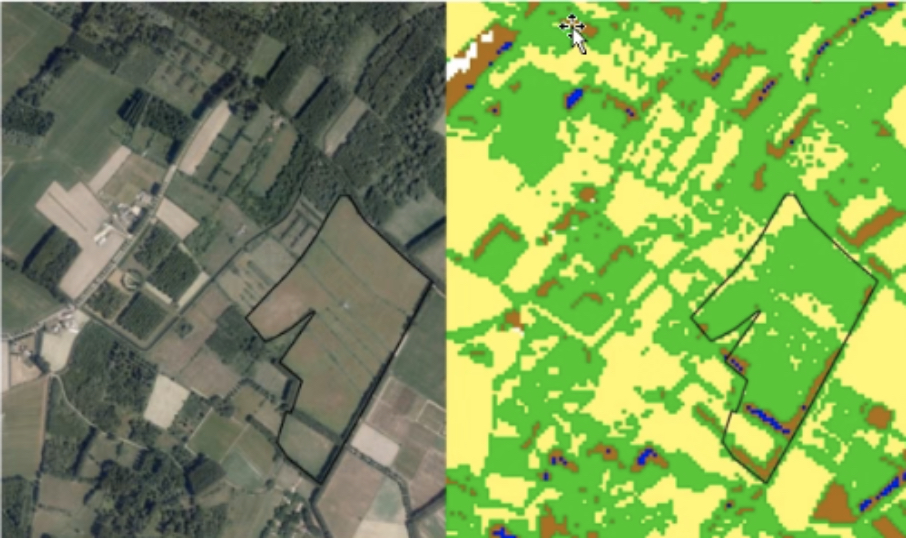
In parallel, remote sensing techniques were applied to map vegetation. Using Sentinel satellite imagery, the Normalized Difference Vegetation Index (NDVI) was calculated.
NDVI is a spectral indicator of plant vitality, derived from the ratio between near-infrared and red-light reflectance. Ground-based NDVI measurements were also taken to validate satellite data. The combined approach resulted in a detailed vegetation map that distinguishes forest patches, grassland, water and cropland around the site.

Challenge

The main challenge was harmonizing field measurements with satellite data. Cloud cover and seasonal conditions introduced discrepancies between ground and remote sensing observations, requiring careful calibration and validation.

GeoIQ deliverables

  • Interpolated soil maps (clay content, water retention capacity, organic matter, calcium content)
  • NDVI-based vegetation maps validated with field data
  • Land-use classification of the food forest and surrounding area

Impact

The project provides the food forest foundation with actionable insight into soil fertility, vegetation health and land-use conditions. These maps help guide planting strategies, monitor ecological succession and support the long-term goal of creating a resilient, self-sustaining ecosystem. The project demonstrates how GIS, field data and remote sensing can be combined for sustainable land management in agroecological projects.

Cart (0 items)

No products in the cart.