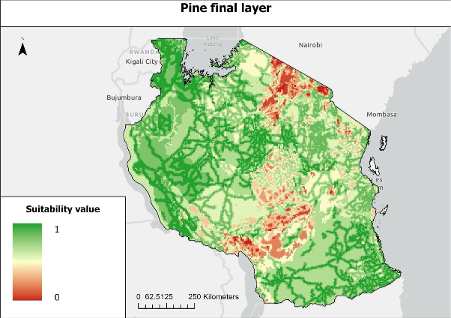
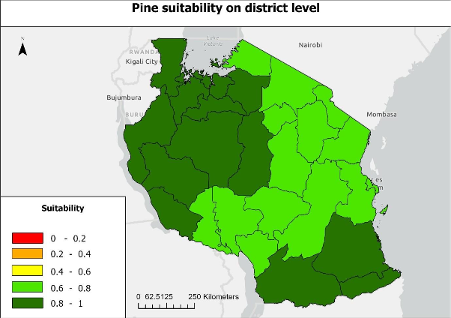
Tanzania faces increasing pressure to balance economic development with sustainable land use and reforestation. To support large-scale planning, GeoIQ Partners conducted a tree species suitability analysis across multiple regions. The objective was to identify where species such as eucalyptus, bamboo and pine can be cultivated under current and future climate conditions, while also incorporating socio-economic factors.
Using a multicriteria analysis (MCA) framework, the study combined key variables including rainfall, temperature, altitude and poverty levels. Each variable was classified and weighted to produce suitability maps that rank regions based on their potential for different tree species. The results highlight priority areas where environmental suitability and socio-economic impact are aligned.
Challenge
The main challenge was integrating diverse datasets, including climate rasters, elevation models and socio-economic indicators, into a consistent, scalable framework at regional level. Additionally, the analysis required balancing ecological suitability with long-term economic viability and community impact.
GeoIQ deliverables
Regional suitability maps for eucalyptus, bamboo, pine and other relevant species
A scalable analytical framework combining climate, topography and socio-economic data
A technical report and dataflow diagram enabling replication and future scenario analysis
Impact
The project provides decision-makers with clear, data-driven insights into where to prioritize tree planting initiatives. By aligning forestry development with both environmental conditions and socio-economic needs, the analysis supports sustainable timber production, carbon sequestration and rural development. It also demonstrates how geospatial intelligence can guide large-scale land-use strategies and climate resilience efforts in Tanzania.

 view
view
 view
view